How I Got Started
with English
My bond with the English language and the English Culture is deep and rich. I love the language, I really enjoy being able to speak, undertand and learn. I am very currious about new words, good words. The influence I had with the English culture, which is not my native culture as Argentinian, is very important and was foundational to who I am today.
On the one hand I am from an Irish family from my mom. My second last name, is Murray and my mom family spoke a rural type of old fashioned Englishman. On the other hand, I grew up in Hurlingham, a place of English culture surrounded by rugby clubs where I played in two of them, Hurling (from 4 to 16) and Curupayti (from 16 to 21). This is my story and present with this beautiful language.
Hurlingham, my neighborhood is located in the Greater Buenos Aires area. It is about 20 km from Argentina’s capital city Buenos Aires. The city was established around the The Hurlingham Club founded in 1888 by the English community in the area, following the original founded in Fulham (United Kingdom). Besides there is a long tradition.
Studies
I went to a bilingual school St Paul’s College a traditional English school with a strong cultural influence that marked me where I received a very decent education and a robust foundation of the language that allowed me to develop professionally and personally. I obtained the Bachelor’s degree with Orientation in Natural Sciences. School provided me access to English. The double schooling that included all the subjects in English added to the international Cambridge exams marked a cultural influence in the way of speaking and writing from kindergarten to finishing high school that helped me to incorporate the language naturally.
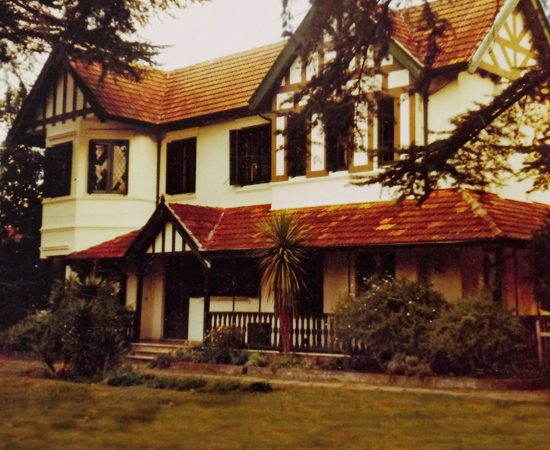
The image is the old and beloved wooden school house from my school years, later it burned down in approximately 1993 and a new building was built where my son Clemente is currently in high school where I hope he can follow the steps of learning good English, fundamental for his develpment.
Speak and Think in English
In the vicinity of my childhood home, where I lived until the age of 12, resided my best friend Marcos Hughes Hallett, also hailing from an English family background. English was the spoken language in his household, I found myself adopting the same linguistic practice. Cherished memories from those early years continue to evoke a sense of joy within me. Also sharing the residence was his cousin, Jessica Gough, with whom I maintain a lasting bond to this day.
However, it was only in my final year of school, under the guidance of Englishman Nick Martin (may he rest in peace 😔), that a significant shift occurred in my relationship with the English language. It was Nick who introduced us to Nigel Robets, an educator from England, tasked with imparting literature classes. This marked a pivotal turning point in my linguistic journey. Mark and I, already close friends, established a strong rapport with both Nick and Nigel, creating a unique and special connection among the four of us. A considerable amount of time was spent together at Nick’s house. The fusion of the rich British cultural heritage with Mark’s inherent roots, which almost rendered him an Englishman, prompted me to actively engage in our conversations.
Our discussions spanned a wide range of captivating topics. It was during this crucial period that I began to speak with increased fluency. Gradually, the habit of mentally translating from Spanish to English waned. I discarded the need to meticulously quote things and instead articulated my thoughts as they arose. Proficiency in English grew within me, and I discovered a genuine fondness for the language. Since then, whenever I engage in English conversation, my thoughts effortlessly flow in English, without the need for translation.
Profesional English 👨🏫
Professional English is light English, that is, smaller, less nourished and more practical. That’s why it’s much easier and faster to learn it. I have some recommendations to get you started. Write and talk frequently, not necesarilly with someone that knows the language just someone who can listen. Is easyer to start talking you have to stop being shy and start acting. Become and actor, exagerate and specially articulate. The best speaker is the one that makes an effort to be undertood.
Conversation Tips
Speaking in English is much simpler than you think. If approached without fear. Without fear of what they say and with the desire to improve oneself by turning it into something fun. I love English and I do it because I learned to enjoy learning it. These are some of the recommendations that I can give with my experience.
Think and Speak in English
When you speak, you have stopped being embarrassed and started saying words, do not translate words in your head from Spanish to English. Say them in English directly, it doesn’t matter if they are right or wrong, you will have time to improve them. This will lead you to think in English and that will greatly improve your spoken language, you will seem like a native. Translating will probably lead you to speak spanglish.
Ahhh instead of Ehhh
Never use the ehhh, when you dont know what to say intead say ahhh. Sometimes while you are speaking it comes naturally to think and often times comes naturally for a spanish speaker to say ehhh between workds. Ehhh in english does not exist, allways use ehhh instead of ahhh.
Writting Tips
Writing a composition or an essay is not the same as a chat with a friend or at work as an email. Each piece of writing requires a different approach and learning how to do it in each case can help a lot. Learn how to write different pieces of communication, for example email.
How to Write an Email
The most important thing in writing a professional email is its efficiency and effectiveness. What we want is for the receiver to clearly understand the message and every detail completely.
Subject: The subject of the email should be a summary of no more than 5 words of the conclusion.
Body: First, begin by addressing the person by their name, then a comma, a line break and the conclusion of what we want to report. Then two line breaks and we expand the conclusion with all the details. If it is very broad we start with a background to give context. Finally, the short and specific greeting with our name at the end, if a greeting before closing is formal.
Hello Name,
Conclusion and summary of the most important thing you want to convey throughout the message, not longer than two lines.
Extended text that explains the conclusion in detail, it can begin with a background to provide context.
Best regards,
Jose
Technolgoy and English
Read Technical Material:
On Technology.
Our Relationship with England 🏴
As it should have been, much better. There are great ties between Argentina and England due to their influence on our country and the number of connections that exist between both peoples. Although it may not seem like it or we try to hide it, we have many more things in common with England than with the United States, for example.
As Argentines, our relationship with England, its culture and language should be broad, wealthy and of enormous respect, much more than with any other nation. We must be able to learn from them and leave the past behind to mature as a country and as a nation. From that place, re-establish a bond as peers. It is very important to learn. However, it is unavoidable not to fall into a position on this issue. Very present for me, in fact my Nenes organization emerged from a competitive aviation squadron made up of young people who traveled to the water’s edge and who had the courage to attack the English command center at the end of the Malvinas War.
Giving an opinion about the English as an Argentinian is and will always be controversial. We have a long relationship with the English people for centuries and it was not always the best. Since our revolution to date, events of no return have occurred that posit both nations almost as enemies. Assuming that’s the case, I think that knowing their idiosyncrasy they can even be good enemies. The English people have a sense of gallantry and the rules of the game that must be recognized and respected. That romantic look at combat, from the Malvinas to rugby where beyond confrontation there is respect and professionalism. That is why if we have to choose an enemy, it would be better for it to be the English and not others who, for example, commit attacks or plant bombs in embassies or hospitals. I have a special appreciation for England, its language, its ancient culture, and yet I belong to one of the few peoples that has decided to go to war. Just like the Zulu War, the Battle of Galipoli and the Malvinas, we are among those people who offered resistance. I wish it had been another way given the great influence they have had on our country. There should always be respect and fair competition at all levels of peace and sport.